
Introduction
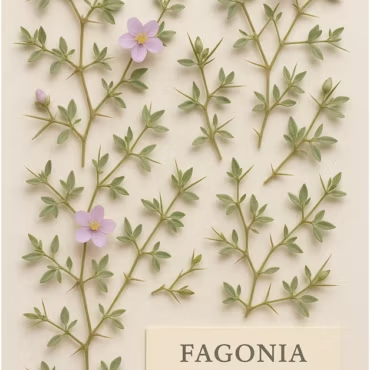
The rise in lifestyle diseases such as strokes and embolisms has increased interest in effective, natural alternatives for thrombolysis—the process of dissolving blood clots. Among these natural alternatives, Fagonia arabica, an herb deeply rooted in traditional Unani medicine, has garnered significant attention. Known for its potent medicinal properties, this herb demonstrates promising potential in managing thrombotic conditions that can lead to paralysis.
Keywords: Fagonia Arabica benefits, natural thrombolytic agents, herbal remedies for stroke, paralysis treatment in Unani medicine, herbal clot dissolution, Fagonia Arabica extract, natural stroke remedies, thrombolytic herbs.
Thrombolytic Activity: Proven Effectiveness
Scientific research has consistently supported the potent thrombolytic properties of Fagonia arabica. Laboratory (in vitro) studies reveal that extracts from Fagonia arabica exhibit substantial clot-dissolving capabilities, achieving clot lysis rates of 65-68%. This is impressively close to the performance of the standard pharmaceutical thrombolytic drug, streptokinase (71-92%). In contrast, control samples with water showed minimal clot dissolution (only 1-3%).
| Agent | Clot Lysis (%) |
| Fagonia Arabica | 65–68 |
| Streptokinase | 71–92 |
| Water (Control) | 1–3 |
Mechanism of Action
Fagonia arabica enhances the body’s natural clot-dissolving mechanisms. It primarily acts by modulating endothelial cell function, increasing the release of tissue plasminogen activator (t-PA) while decreasing its inhibitor (PAI-1). This dual action effectively counteracts thrombin formation, promoting efficient fibrinolysis (natural breakdown of clots).
Animal Studies: Demonstrated Synergy and Enhanced Outcomes
Animal model studies further confirm the efficacy of Fagonia arabica, notably when combined with complementary natural cardiotonic extracts. Research involving mice subjected to conditions like myocardial infarction (heart attacks) and cerebral infarction (brain strokes) showed that Fagonia arabica, alone or in combination, markedly reduced blood clots and enhanced recovery. These findings highlight its potential in preventing paralysis associated with stroke and embolism.
Potential Role in Paralysis Management
Paralysis resulting from stroke or embolism is typically due to thrombotic blockages in critical blood vessels. Given the demonstrated clot-dissolving efficacy of Fagonia arabica, it holds significant promise for managing such conditions. While direct studies specifically addressing paralysis are still limited, the robust clot-dissolving properties demonstrated by Fagonia arabica underscore its potential as an effective natural treatment.
Safety and Future Perspectives
Initial findings are promising, yet comprehensive clinical trials are necessary to conclusively establish the safety profile and clinical effectiveness of Fagonia arabica in humans. Unani practitioners and researchers continue to advocate for thorough studies to validate traditional claims and integrate this powerful herb into mainstream therapeutic regimens safely.
Conclusion
Fagonia arabica emerges as a potent natural thrombolytic agent, offering promising therapeutic avenues for stroke-related paralysis. Its compelling performance in both laboratory and animal studies highlights the potential of this traditional Unani remedy as a complementary treatment option. Continued research and clinical trials will pave the way for broader acceptance and use in modern therapeutic practices.
Add Comment